Agra is a city on the banks of the Yamuna river in the Indian state of Uttar Pradesh.[8] It is 206 kilometres (128 mi) south of the national capital New Delhi. Agra is the fourth-most populous city in Uttar Pradesh and 24th in India.[9]
Agra is a major tourist destination because of its many Mughal-era buildings, most notably the Taj Mahal, Agra Fort and Fatehpur Sikri, all of which are UNESCO World Heritage Sites.[8] Agra is included on the Golden Triangle tourist circuit, along with Delhi and Jaipur; and the Uttar Pradesh Heritage Arc, a tourist circuit of Uttar Pradesh, along with Lucknow and Varanasi. Agra is in the Braj cultural region.
The history of Agra before the Delhi Sultanate is unclear. A 17th century chronicle called it an old settlement which was merely a village, owing to its destruction by Mahmud of Ghazni, before Sikandar made it his capital.[10] The 11th-century Persian poet Mas’ūd Sa’d Salmān writes of an assault on the fortress of Agra, then held by King Jaypal, by Sultan Mahmud of Ghazni. Despite his surrender, Mahmud sacked the place.[11] It was mentioned for the first time in 1080 AD when a Ghaznavide force captured it. Sultan Sikandar Lodī (1488–1517) was the first to move his capital from Delhi to Agra in 1504, its administration having previously been under Bayana.[12][13] He governed the country from here and Agra assumed the importance of the second capital. He died in 1517 and his son, Ibrāhīm Lodī, remained in power there for nine more years. Several palaces, wells, and a mosque were built by him in the fort during his period. He was finally defeated at the Battle of Panipat in 1526.[14] Between 1540 and 1556, Afghans, beginning with Sher Shah Suri, ruled the area. It was the capital of the Mughal Empire from 1556 to 1648. The city was later taken by the Marathas and later still fell to the British Raj.

THE GREAT TAJ MAHAL:
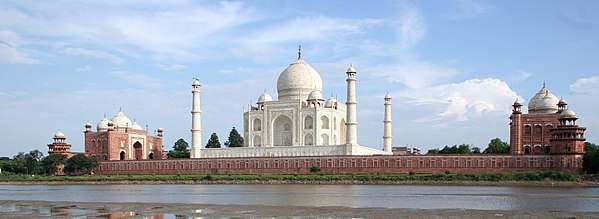
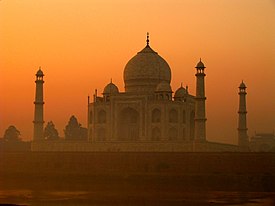
The Taj Mahal is one of the most famous buildings in the world, the mausoleum of Shah Jahan‘s favourite wife, Mumtaz Mahal. It is one of the New Seven Wonders of the world, and one of the three World Heritage Sites in Agra. Agra is commonly identified as the “City of Taj”.[44]
Completed in 1653, the Taj Mahal was built by the Mughal king Shah Jahan as the final resting place for his beloved wife, Mumtaz Mahal. Finished in marble, it is one of India’s many beautiful monuments and is set amidst landscaped gardens. Built by the Persian architect, Ustād ‘Īsā, the Taj Mahal is on the south bank of the Yamuna River. It can be observed from Agra Fort from where Emperor Shāh Jahān gazed at it for the last eight years of his life, a prisoner of his son Aurangzeb. Verses of the Quran are inscribed on it and at the top of the gate are 22 small domes, signifying the number of years the monument took to build. The Taj Mahal was built on a marble platform that stands above a sandstone one. The most elegant dome of the Taj Mahal has a diameter of 60 feet (18 m), and rises to a height of 80 feet (24 m); directly under this dome is the tomb of Mumtaz Mahal. Shah Jahān’s tomb was erected next to hers by his son Aurangzeb. The interiors are decorated with fine inlay work, incorporating semi-precious stones.
FATEHPUR SIKRI :
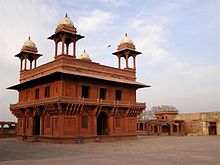
The Mughal Emperor Akbar built Fatehpur Sikri about 35 km (22 mi) from Agra, and moved his capital there. Later abandoned, the site displays a number of buildings of significant historical importance. A World Heritage Site, it is often visited by tourists. The name of the place came about after the Mughal Emperor Bābar defeated Rāṇā Sāngā in a battle at a place called Sikrī (about 40 km (25 mi) from Agra). Then the Mughal Emperor Akbar wanted to make Fatehpur Sikri his headquarters, so he built a majestic fort; due to the shortage of water, however, he had to ultimately move his headquarters to Agra Fort.
Buland Darwāza or ‘the lofty gateway’ was built by the great Mughal emperor, Akbar in 1601 CE. at Fatehpur Sikri. Akbar built the Buland Darwāza to commemorate his victory over Gujarat. The Buland Darwāza is approached by 52 steps. The Buland Darwāza is 53.63 metres (175.95 feet) high and 35 metres (115 feet) wide. it is made of red and buff sandstone, decorated by carving and black and white marble inlays. An inscription on the central face of the Buland Darwāza demonstrates Akbar’s religious broadmindedness, it is a message from Jesus advising his followers not to consider this world as their permanent home.
 GRISHI BEING TRAVELLER